A newer BMW can be mechanically healthy, free of warning lights, and still have a major limitation when an owner wants custom engine calibration. The issue is often the engine control module, commonly called the DME. A BMW DME unlock service is not a generic tuning appointment or a software file loaded in a parking lot. It is an electronics procedure that requires identifying the exact vehicle, DME type, software level, vehicle condition, and the customer’s intended use before any programming decision is made.
For BMW owners in Orlando and Central Florida, that distinction matters. Florida heat, stop-and-go traffic, existing cooling-system concerns, aging ignition components, and previous modifications can all affect whether a tuning project is appropriate. The best results start with a vehicle that has been inspected, diagnosed, and prepared correctly.
What the BMW DME Controls
The DME is BMW’s engine management computer. It processes information from sensors throughout the engine and manages functions such as fuel delivery, ignition timing, boost control on turbocharged engines, throttle operation, camshaft timing, torque management, and diagnostic monitoring. Modern BMW DMEs also communicate constantly with the transmission controller, stability-control system, body modules, immobilizer system, and factory diagnostic network.
That level of integration is why engine software changes are not a casual modification. A calibration affects more than peak power. It can change how the engine responds to throttle input, controls boost, manages torque during shifts, and responds to fuel quality and temperature. The DME must remain stable, correctly identified, and compatible with the vehicle’s other control modules.
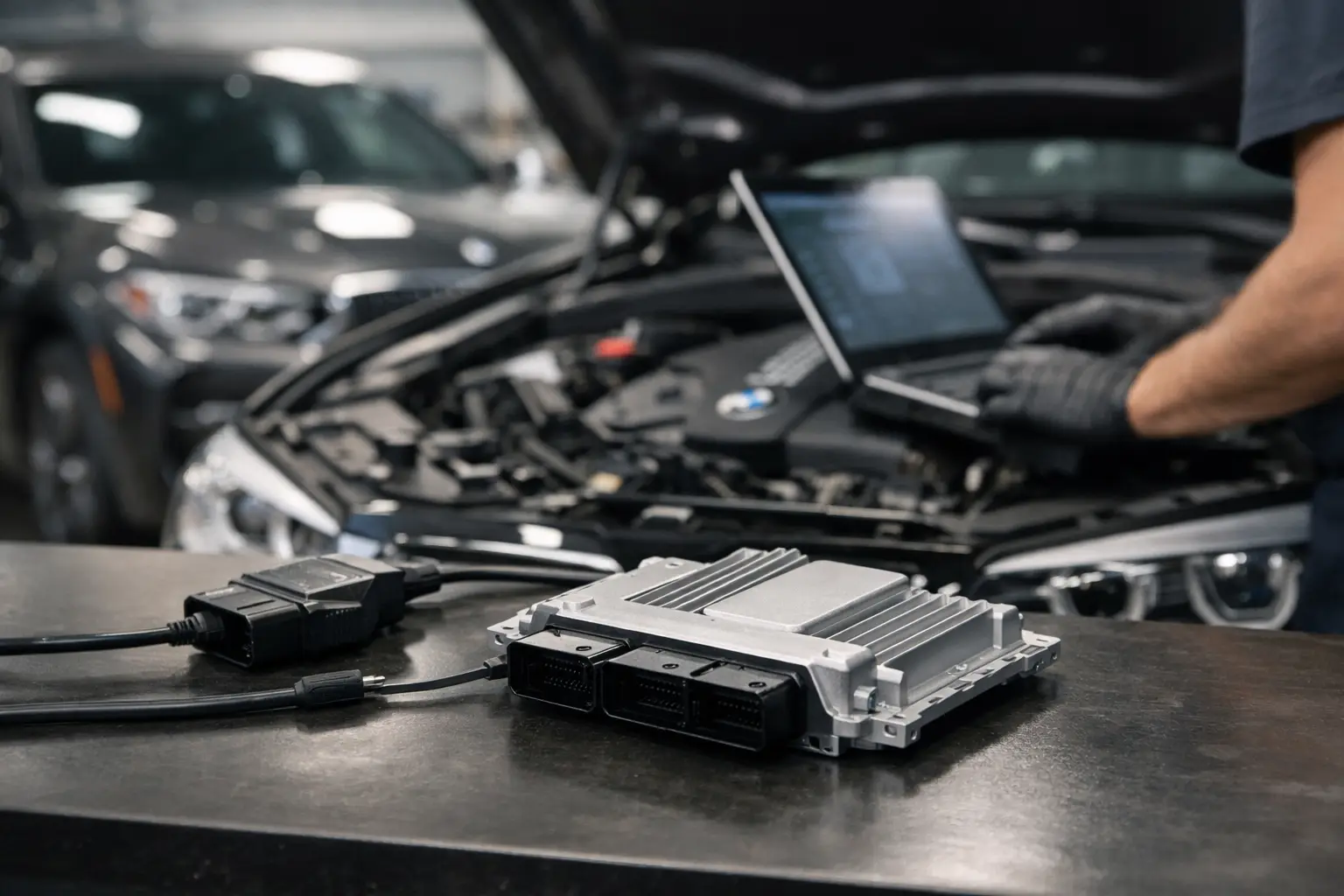
On many late-model BMW applications, the factory DME includes security measures that prevent routine flash programming through the diagnostic port. This is where an authorized BMW DME unlock service may be relevant for customers pursuing legitimate calibration work on a supported vehicle. The required approach varies by model year, engine family, DME hardware, and current software version.
Why Newer BMWs Need a Different Process
Older BMW engine computers were generally more accessible through conventional programming methods. Newer platforms may require more involved procedures, including professional bench or boot work when appropriate. That means the DME may need to be removed and handled in a controlled environment rather than simply connected to a handheld device.
The correct method depends on the specific DME and software state. Assumptions based on another owner’s forum post, a different model year, or a similar-looking engine can create expensive problems. BMW changes control-module hardware and software frequently, sometimes within the same chassis generation.
A proper assessment begins with a full vehicle scan and verification of the DME identification data. The technician should confirm the module part number, software details, fault memory, programming history where available, and communication status. If the vehicle has unresolved faults, battery-voltage concerns, previous failed programming, or signs of water intrusion, those issues need attention first.
When a BMW DME Unlock Service Is Appropriate
This service is usually considered by owners who want a supported custom calibration or need advanced DME programming work beyond standard diagnostic access. It may also be part of a recovery plan when a module has software corruption or an incomplete programming event, although recovery work and performance calibration are different jobs with different goals.
Before proceeding, it helps to be clear about the vehicle’s purpose. A daily-driven BMW in Orlando traffic has different needs than a weekend car or a track-focused build. The desired power level, fuel used, intake and exhaust changes, charge-air cooling, transmission calibration, tire condition, and maintenance history all influence what is sensible.
For example, increasing output on a turbo BMW without verifying spark plugs, coils, cooling performance, fuel trims, and boost-control operation can turn a small maintenance issue into a drivability complaint. A tune does not repair a weak charge pipe, a leaking valve cover, worn plugs, a marginal battery, or a cooling system that cannot maintain operating temperature.
At Eurocraft Automotive, BMW DME unlock service starts at $249 for supported vehicles. When an eligible Eurocraft Automotive in-house performance tune is purchased, the DME unlock may be included at no additional charge. The exact procedure and available tuning options must still be verified from the vehicle information, DME type, and software level.
We recommend providing the VIN before scheduling so the vehicle can be identified correctly before work begins.
Diagnosis Comes Before Programming
At Eurocraft Automotive, advanced electronics work is approached as a diagnostic process, not a push-button transaction. A pre-service evaluation should include a comprehensive fault scan, confirmation of stable system voltage, review of engine operating data, and inspection of relevant maintenance items. Depending on the vehicle and intended calibration, this may include checking for misfires, fuel-pressure irregularities, air leaks, cooling concerns, and transmission-related faults.
Battery support is particularly important. Programming and module communication are sensitive to voltage changes. A weak battery or improper power support can interrupt a procedure and leave a module in a non-operational state. That is one reason professional programming setups use controlled power equipment and established recovery procedures.
It is also important to identify any prior work. A BMW that has already been modified, coded, programmed by another shop, or fitted with aftermarket electronics may require additional verification. The goal is not to criticize previous work. It is to understand the vehicle’s actual starting point before making changes that depend on reliable module communication.
The Trade-Offs Owners Should Understand
Engine calibration can improve response and performance when it is matched to the vehicle, fuel, hardware, and use case. It can also increase heat, load, and stress on components. The amount of trade-off depends on the engine, calibration strategy, maintenance condition, and how the vehicle is driven.
There are practical ownership considerations as well. Dealer software updates can change the DME software level and may affect existing programming. Warranty coverage may be affected by modifications, and some modifications may not be legal for public-road use or may interfere with emissions compliance. Customers should understand those implications before authorizing work.
A responsible shop should be direct about what can and cannot be predicted. No one can promise that every modified vehicle will behave identically in every temperature, fuel condition, or driving situation. Good calibration work reduces unnecessary risk by using accurate vehicle data, sensible targets, and proper supporting maintenance, but it does not eliminate the need for continued care.
Choosing the Right Shop for DME Work
The equipment is only one part of the job. BMW DME work requires knowledge of module communication, programming protocols, software recovery, wiring integrity, power management, and the relationship between the DME and other vehicle systems. A shop should be able to explain what it is checking, why a particular procedure is appropriate, and what the next steps are if the vehicle has an unexpected software or communication issue.
Transparency matters just as much. Before work begins, the owner should know whether the module must be removed, what supporting repairs or maintenance may be recommended, whether the vehicle’s current software affects the process, and what realistic outcomes to expect. If the vehicle is not a good candidate at that moment, the right answer may be to correct mechanical or electrical issues first.
Eurocraft Automotive combines advanced diagnostics, BMW programming and coding, mechanical repair, and performance calibration under one roof. That becomes especially important when something does not go as expected.
Anyone can offer an unlock. Not everyone can fix what goes wrong.
Protecting the Vehicle After the Work
After DME programming or calibration work, maintenance becomes even more important. Follow the recommended oil-service schedule, use the correct fuel for the calibration, address warning lights promptly, and do not ignore new misfires, reduced-power messages, coolant loss, or transmission concerns. These symptoms may be unrelated to the software, but they deserve diagnosis rather than guesswork.
Keep records of the vehicle’s software work, maintenance, and installed hardware. That information helps when troubleshooting later and is useful if the vehicle receives future module programming. It also gives the next technician a more accurate picture of the car, which can save time and prevent unnecessary parts replacement.
The right BMW DME decision is not always the fastest one. A clear diagnostic baseline, proper module handling, and honest discussion about how the car will be used provide a better foundation than chasing a number or copying another vehicle’s setup.
For BMW DME unlock, programming, diagnostics, or performance tuning in Orlando, contact Eurocraft Automotive at 407-512-5877 or use our appointment page to send us the VIN and vehicle information.