Table of Contents
- Understanding Performance Upgrades for European Vehicles
- ECU Tuning and Engine Optimization
- European Vehicle Module Programming and DME Unlock
- DME Unlock Services in Orlando
- Suspension and Braking Upgrades
- Exhaust and Intake Modifications
- Service and Diagnostics After Performance Modifications
- Frequently Asked Questions
Last Updated: September 21, 2026
Performance upgrades european vehicles represent one of the most significant decisions an owner can make, especially when balancing power gains against reliability and long-term durability. At Eurocraft Automotive in Orlando, we work with owners who want to extract more from their BMW, Mercedes-Benz, Audi, Volkswagen, and Porsche without compromising the engineering integrity that makes these vehicles worth owning. The question isn’t whether performance upgrades are possible, it’s which approach aligns with your vehicle’s condition, your driving habits, and your tolerance for modification.
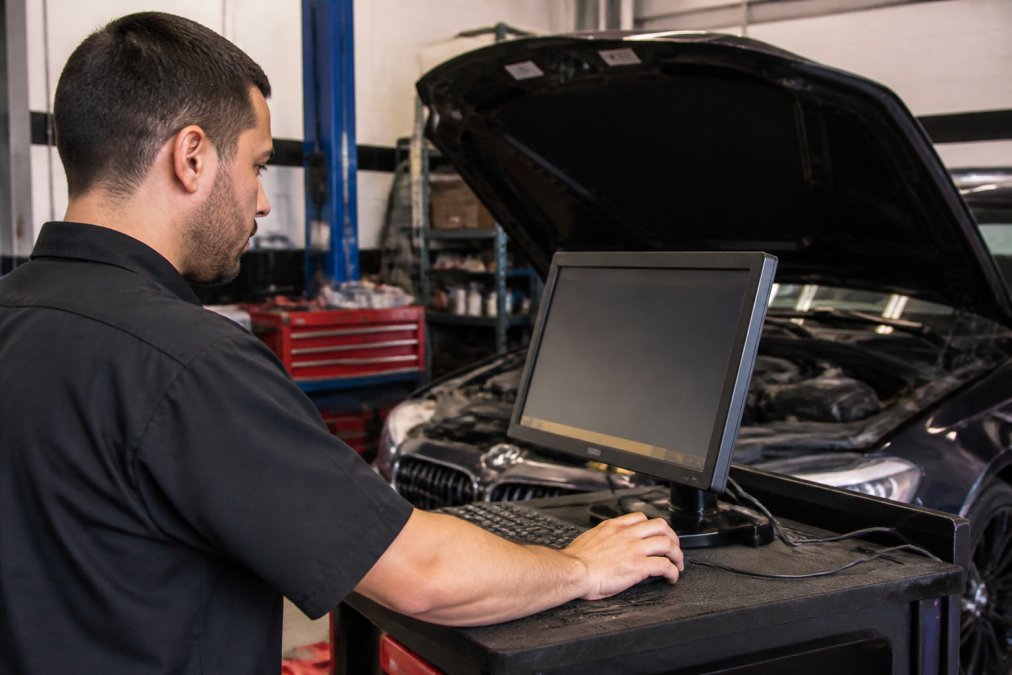
Understanding Performance Upgrades for European Vehicles
Performance upgrades for European vehicles fall into distinct categories, each with different technical requirements and outcomes. The most common modifications involve engine management tuning, suspension refinement, braking system upgrades, and exhaust optimization. What separates a successful upgrade from a problematic one is understanding how these systems interact within the factory design and what happens when you push beyond factory parameters.
European vehicles are engineered with tight tolerances and integrated electronics. A change to one system often ripples through others. For example, increasing engine output without addressing cooling capacity or fuel system limitations can create new problems. This is where proper diagnostics and module-level programming become essential rather than optional.
The Orlando area has a growing community of European vehicle owners who recognize that dealership-only service limits their options. Many discover that independent specialists with advanced diagnostic equipment and programming capability can deliver performance upgrades that dealerships won’t attempt, along with the technical knowledge to do it safely.
ECU Tuning and Engine Optimization
How ECU Tuning Works
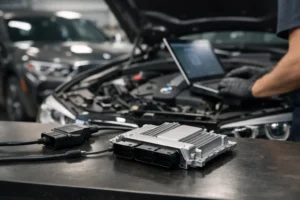
ECU tuning modifies the engine control unit’s firmware to alter fuel injection timing, boost pressure, ignition timing, and other parameters that govern engine output. The process begins with reading the factory ECU map, the baseline programming that defines how your engine behaves under all conditions. A technician then adjusts this map based on the vehicle’s specifications, fuel quality available in your region, and your performance goals.
The adjustment isn’t arbitrary. Modern tuning software accounts for engine load, ambient temperature, fuel octane rating, and dozens of other variables. A proper tune for a turbocharged engine in Central Florida’s climate differs from one optimized for cooler regions, because heat and humidity affect air density, combustion temperatures, and component stress.
Common outcomes from ECU tuning include increased horsepower and torque across the RPM range, improved throttle response, and sometimes better fuel efficiency during steady-state driving. The actual gains depend on whether your vehicle is naturally aspirated, turbocharged, or supercharged, and whether the engine has already been modified.
Warranty and Reliability Considerations
ECU tuning can affect manufacturer warranty coverage on engine-related components. This is a reality that deserves honest discussion. If something fails, you may bear the cost of repair rather than the manufacturer.
Reliability depends almost entirely on how conservatively the tune is applied. A modest increase in boost pressure and fuel delivery on a well-maintained engine tends to be stable. Aggressive tuning that pushes thermal and mechanical limits creates risk. The technician’s experience and restraint matter more than the software itself.
Eurocraft Automotive approaches tuning with emphasis on sustainable performance rather than maximum output. We test thoroughly after any ECU modification and recommend regular maintenance intervals that match the increased stress on engine components. This reflects how experienced technicians actually approach the work.
European Vehicle Module Programming and DME Unlock
What Module Programming Achieves
Module programming extends beyond the engine control unit to transmission control modules, body electronics, suspension computers, and other integrated systems. European vehicles, particularly BMW and Mercedes models, rely on networked modules that communicate constantly. Programming one module often requires recalibrating others to prevent fault codes and drivability issues.
Common module programming tasks include enabling features that were disabled from the factory, adapting the transmission shift logic to match a tuned engine, recoding comfort features, and unlocking performance parameters in models where the hardware supports more output than the factory firmware allows.
DME unlock specifically refers to removing software restrictions on BMW engine management systems. Many BMW models ship with detuned versions of their engines, the hardware can support higher output, but the firmware limits it. Unlocking accesses that potential without hardware modification.
DME Unlock Services in Orlando
DME unlock for BMW vehicles in the Orlando area requires specialized equipment and deep familiarity with BMW’s modular architecture. The process involves reading the DME firmware, identifying the restriction parameters, and carefully modifying them while preserving the vehicle’s stability and emissions compliance.
Not every BMW benefits from DME unlock. Vehicles with high mileage, known cooling system issues, or marginal fuel system capacity become risky candidates. A thorough pre-unlock diagnostic is essential. This is where advanced diagnostics separate professional work from amateur attempts.
Eurocraft Automotive performs comprehensive pre-unlock evaluation including fuel system pressure testing, cooling system analysis, and electrical load assessment. We identify whether your specific vehicle is a good candidate and what supporting modifications, if any, should accompany the unlock to ensure reliability.
Suspension and Braking Upgrades
Suspension upgrades for performance-oriented driving typically involve lowering springs, adjustable dampers, upgraded sway bars, and sometimes differential bushings or control arm reinforcement. The goal is reducing body roll, improving turn-in response, and keeping the tire contact patch more consistent during aggressive driving.
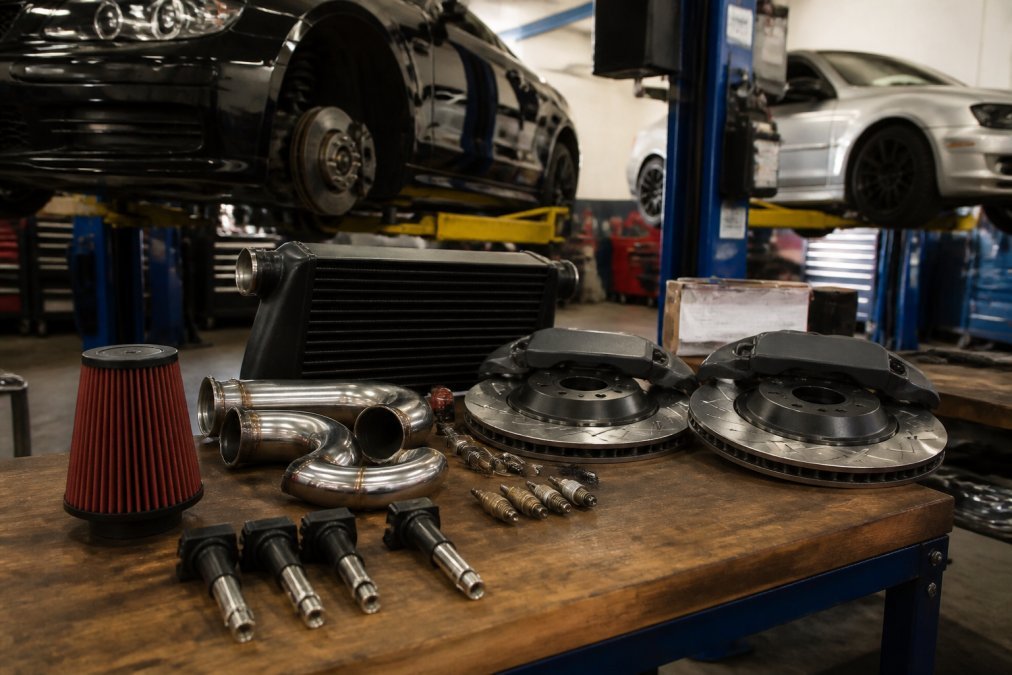
Braking upgrades range from higher-friction brake pads and braided steel lines to complete rotor and caliper changes. European vehicles often come with capable brake systems from the factory, but upgrading to larger rotors, multi-piston calipers, or high-performance pads can improve stopping power and fade resistance during sustained hard braking.
The interaction between suspension and braking matters. Lowering a vehicle without adjusting alignment can create uneven tire wear and unpredictable brake behavior. Upgrading brakes without matching suspension geometry changes can lead to nose-dive under braking and reduced cornering grip.
Exhaust and Intake Modifications
Exhaust modifications reduce backpressure and improve scavenging, allowing the engine to breathe more freely at higher RPMs. This typically involves a cat-back exhaust system, everything downstream of the catalytic converter, or sometimes a full exhaust including a high-flow catalytic converter or sports cat.
Intake modifications increase the volume and velocity of air entering the engine. Cold air intakes, intake manifold upgrades, and throttle body modifications all serve this purpose. The gains from intake work alone are modest, but combined with ECU tuning and exhaust modification, they contribute to overall performance improvement.
Both modifications generate noise. A performance exhaust will be noticeably louder than factory, and intake noise becomes audible during acceleration. This is aesthetic as much as functional, and it’s worth considering whether the sound matches your driving environment and daily use.
Service and Diagnostics After Performance Modifications
Once modifications are in place, your vehicle needs different maintenance. Tuned engines typically benefit from more frequent oil changes because the higher combustion temperatures and pressures generate more engine wear byproducts. Upgraded suspension components may require more frequent inspection for wear. Brakes that see harder use need more regular pad assessment.
Diagnostic capability becomes more important after modification. If a fault code appears, you need a technician who understands both the factory system and the modifications you’ve made. Generic scan tools often can’t interpret the data properly on a modified vehicle.
Eurocraft Automotive maintains detailed records on every modification we perform and every diagnostic we conduct. When you bring a modified vehicle in for service, we know exactly what’s been changed and can assess whether those changes are performing as intended or creating secondary issues.
| Upgrade Category | Primary Benefit | Key Consideration |
|---|---|---|
| ECU Tuning | Increased power and torque | Voids warranty; requires quality fuel |
| Module Programming | Feature unlocking; system integration | Requires specialized diagnostic equipment |
| DME Unlock | Access to hidden engine potential | Pre-unlock diagnostics essential |
| Suspension Upgrades | Improved handling and cornering | Requires alignment and geometry adjustment |
| Braking Upgrades | Better stopping power and fade resistance | Should match suspension capability |
| Exhaust Modifications | Improved scavenging and response | Generates noise; affects emissions |
Performance upgrades european vehicles in Orlando succeed when they’re matched to your vehicle’s baseline condition, your driving goals, and your willingness to maintain the vehicle at a higher level of care. The most powerful upgrade is honest diagnostics that tell you what your specific vehicle can safely handle.
If you’re considering performance upgrades or have questions about what’s appropriate for your European vehicle, Eurocraft Automotive is equipped to evaluate your car thoroughly and discuss realistic options. We work with owners who want genuine performance improvement, not hype. Contact us to schedule a diagnostic consultation and discuss your vehicle’s potential.
European vehicle performance upgrades in Orlando demand technical expertise and honest assessment. Eurocraft Automotive provides factory-level diagnostics, ECU and module programming, and performance optimization tailored to your specific vehicle.
Frequently Asked Questions
Does ECU tuning void my European vehicle’s warranty?
ECU tuning can affect warranty coverage depending on your vehicle’s age and the tuning method used. Many manufacturers will not honor warranty claims on components directly affected by the modification. Some tuning solutions offer reversibility, allowing you to restore original settings if needed. Before pursuing ECU tuning, discuss the implications with your service provider. At Eurocraft Automotive, we explain warranty impacts clearly so you can make an informed decision about performance upgrades for your European vehicle.
What is the difference between ECU and TCU tuning for European cars?
ECU tuning modifies engine parameters like fuel injection, ignition timing, and boost pressure to increase power and efficiency. TCU tuning adjusts transmission shift points, pressure, and response characteristics for faster acceleration and smoother shifts. Some European vehicles benefit from both modifications working together. ECU tuning focuses on engine output, while TCU tuning optimizes how power is delivered through the transmission. Both require precise calibration specific to your vehicle’s model and current software version.
How often should I service my European car after performance modifications?
Performance upgrades typically increase engine stress, so more frequent maintenance becomes important. Oil changes may be needed sooner, spark plugs may wear faster, and cooling system efficiency becomes critical. We recommend discussing a maintenance schedule with your technician after any significant modification. Eurocraft Automotive provides comprehensive diagnostics and service planning for modified European vehicles to ensure long-term reliability and performance.
Do I need specialized diagnostics after installing performance parts?
Yes. After performance modifications, specialized diagnostics help verify that all systems are functioning correctly and that no fault codes have been triggered. Advanced diagnostic equipment can monitor engine parameters, transmission behavior, and module communication to confirm the upgrade is working as intended. Eurocraft Automotive uses factory-level diagnostics to validate performance upgrades and catch any issues early, protecting your investment in your European vehicle.