Table of Contents
- Complex Electronics and Advanced Diagnostic Requirements
- Precision Engineering and Tight Tolerances
- Why European Car Diagnostic Services Require Specialized Equipment
- European Vehicle Module Programming and Control Systems
- OEM Parts, Fluid Specifications, and Material Standards
- Finding BMW Auto Repair and European Specialists Near You
- Common Issues That Arise From Improper Maintenance
- Frequently Asked Questions
Last Updated: September 25, 2026
European vehicles are engineered to exacting standards that demand equally precise maintenance. The reason why European cars need specialized maintenance goes far deeper than brand loyalty or marketing, it’s rooted in their fundamental design philosophy, advanced electronics, and the specific materials and tolerances used throughout their construction. At Eurocraft Automotive in Orlando, we work on BMW, Mercedes-Benz, Audi, Volkswagen, Porsche, and other European marques. Vehicles built to these specifications require technicians who understand their architecture at a level that generic repair shops simply don’t possess.
This guide explains the technical reasons why European cars need specialized maintenance, what happens when they don’t receive it, and how to find the right specialist for your vehicle.
Complex Electronics and Advanced Diagnostic Requirements
European luxury and performance vehicles contain integrated electronic control systems that manage everything from fuel injection and ignition timing to transmission shifts, suspension damping, and brake force distribution. A single vehicle may have 50 to 100 electronic control modules communicating across multiple networks. When something goes wrong, a generic code reader won’t cut it.
The diagnostic equipment required to properly interrogate these systems is specialized and expensive. A technician needs factory-level diagnostic software, manufacturer-specific scan tools, and deep knowledge of how these modules communicate with one another. When a warning light appears on your dashboard, the underlying cause might be a sensor, a wiring issue, a software glitch, or a combination of factors that only reveals itself through proper module communication testing. Advanced Diagnostics at this level requires investment in equipment and training that separates true specialists from general repair shops.
Many vehicle owners discover this the hard way. A shop with standard diagnostic tools might identify a fault code related to the transmission and recommend a transmission overhaul. A specialist equipped with proper diagnostics might find that the issue is actually a faulty sensor or a software calibration problem. This is why European car diagnostic services require specialized equipment and training.
European vehicles often store multiple fault codes that point to secondary symptoms rather than root causes. Proper diagnosis requires tracing the communication chain between modules, not just reading the most obvious code. This is where specialist knowledge separates correct diagnosis from expensive guesswork.
Precision Engineering and Tight Tolerances
European automotive engineering prioritizes performance and longevity through tight mechanical tolerances. Engine blocks, cylinder heads, and drivetrain components are manufactured to specifications measured in fractions of a millimeter. This precision delivers efficiency, power delivery, and durability, but only when maintenance is performed to the same standard.
Using incorrect oil viscosity, for example, isn’t just a minor deviation. European engines are calibrated for specific oil flow rates and film strength. The wrong oil can affect fuel economy, increase wear on hydraulic valve lifters, compromise turbocharger bearing lubrication, and even trigger limp-mode operation. Similarly, brake fluid specifications matter. European vehicles often use high-performance brake systems with precise pressure requirements. Mixing brake fluid types or using fluid that absorbs moisture can compromise braking performance and damage expensive ABS modules.
Suspension geometry on European performance vehicles is set to factory specifications that affect handling, tire wear, and safety. Alignment isn’t just about straight-line tracking, it’s about maintaining the precise angles that optimize grip and stability. A shop that doesn’t understand these tolerances might perform an alignment that passes a standard check but deviates from manufacturer specs, leading to premature tire wear and handling changes the owner notices immediately.
Precision engineering means precision maintenance. A 0.5% deviation in oil viscosity or a 0.2-degree change in suspension angle might seem negligible, but these vehicles are designed with zero tolerance for such variation.
Why European Car Diagnostic Services Require Specialized Equipment
The diagnostic landscape for European vehicles has evolved far beyond simple code readers. Modern European vehicles use multiple communication protocols, CAN-bus, K-line, and proprietary networks, that require tools capable of accessing each one. Factory diagnostic software like BMW’s ISTA, Mercedes’ DTS, or Audi’s VAS provide access to live data streams, module reprogramming, and system tests that aftermarket tools simply cannot replicate.
Consider an electrical fault that causes intermittent dashboard warnings. A generic scanner might show no codes. A factory diagnostic tool can monitor sensor signals in real time, perform electrical continuity tests, and access module memory to identify intermittent faults that have since cleared. This capability is the difference between solving the problem and telling the customer “we can’t find anything wrong.”
Specialized diagnostic equipment also enables technicians to perform system resets, module initialization, and adaptation procedures that are essential after repair work. Replacing a door module, for example, isn’t just about physical installation, the new module must be coded to the vehicle, initialized with the correct variant data, and adapted to the specific vehicle configuration. Without proper diagnostics and coding, the module won’t function correctly, and warning lights will persist.
Eurocraft Automotive uses factory-level diagnostic systems for every vehicle that comes through our door. This investment in equipment reflects the reality that proper diagnosis requires proper tools. When you bring your European vehicle to a specialist in Orlando, you’re paying for access to the same diagnostic capability that dealerships use, which is what your vehicle actually needs.
European Vehicle Module Programming and Control Systems
Modern European vehicles are essentially computers on wheels. Every major system, engine, transmission, suspension, lighting, climate control, is managed by software running on dedicated control modules. When a module fails or needs replacement, it must be programmed with the correct software version, variant data, and adaptation parameters specific to your vehicle.
This is where the complexity multiplies. A replacement engine control module isn’t a generic part. It must be coded to match your vehicle’s specific configuration: engine displacement, fuel system type, emission controls, transmission type, and more. If the coding is incorrect, the engine won’t run properly, fuel economy will suffer, and you may experience limp-mode operation or inability to start.
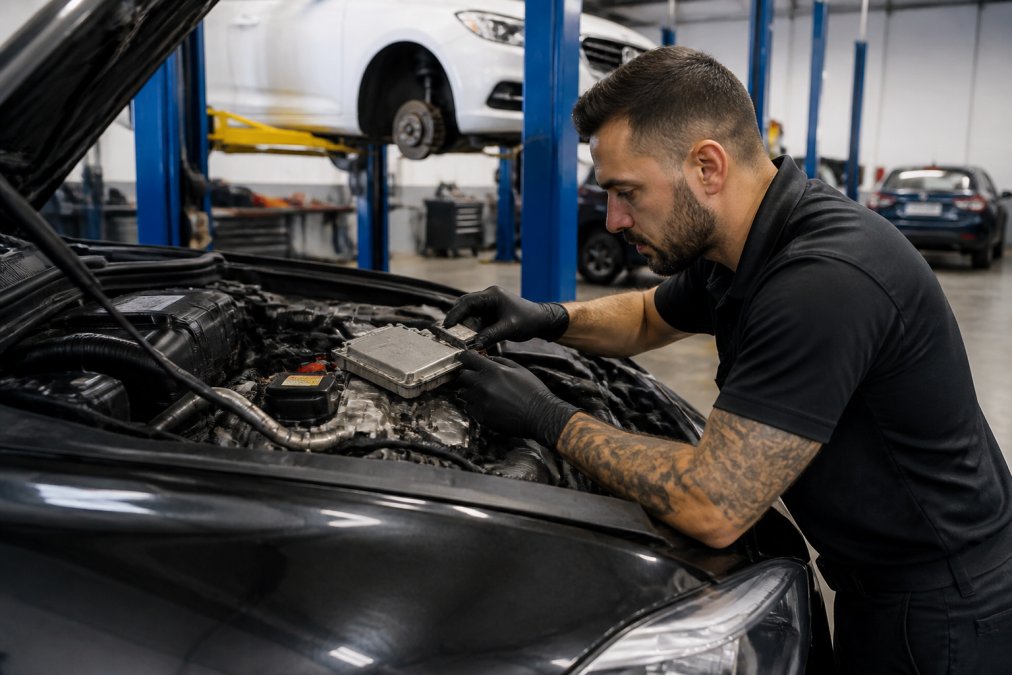
Transmission control modules require similar precision. A TCU from a different model year or engine variant won’t work correctly in your vehicle, even if it’s physically compatible. The module must be programmed with the correct transmission type, gear ratios, shift logic, and torque converter characteristics. Incorrect programming leads to harsh shifts, transmission hunting between gears, or complete transmission dysfunction.
The same principle applies to body control modules that manage lighting, climate, and comfort features. A replacement module must be coded to recognize which options your vehicle has, which lights are installed, which climate zones exist, which seat heating elements are present. Without proper coding, features won’t work, or the module will throw errors.
Programming & Coding for European vehicles requires specialized software, access to manufacturer databases, and technicians trained in the specific procedures for each brand. This isn’t something a general technician can improvise. Eurocraft Automotive maintains current software licenses and training for the vehicles we service, ensuring that every programming job is done to factory specification.
OEM Parts, Fluid Specifications, and Material Standards
European manufacturers specify exact materials and fluid types for every component. This isn’t arbitrary, it reflects engineering decisions about durability, performance, and compatibility with other systems.
Brake fluid is a clear example.
Using incorrect fluids in European vehicles can trigger limp-mode operation, disable advanced features, or cause component failure. The cost savings from using cheaper fluids disappears instantly when a transmission, cooling system, or engine requires replacement.
Finding BMW Auto Repair and European Specialists Near You
When evaluating a specialist, ask specific questions:
Diagnostic Capability, Do they have factory-level diagnostic software for your specific brand? Can they access live data, perform module coding, and run manufacturer-specific tests? If they’re uncertain about their diagnostic capability, that’s a red flag.
Common Issues That Arise From Improper Maintenance
The consequences of inadequate maintenance compound over time. A vehicle that receives generic maintenance for two or three years may function acceptably, but underlying problems develop silently.
Frequently Asked Questions
Why is European car maintenance more expensive than domestic vehicles?
European cars incorporate advanced electronics, precision-engineered components, and specialized systems that demand factory-level diagnostics and OEM parts. Diagnostic tools, software licenses, and technician training for European vehicles cost more than for domestic cars. Additionally, tolerances are tighter, fluids are often proprietary, and control module programming requires specialized equipment that independent shops must invest in significantly.
What makes European vehicle module programming different from standard diagnostics?
European vehicles use networked control modules (ECU, DME, TCU, BCM) that communicate across multiple systems. Programming and coding these modules requires manufacturer-specific software, security access protocols, and deep knowledge of module adaptation. A standard diagnostic scan cannot reprogram modules or adapt new components; specialized software and technical expertise are essential to prevent drivability issues or electrical faults after repairs.
Can a general mechanic handle European car maintenance safely?
General mechanics may handle basic maintenance, but European vehicles have systems and tolerances that demand specialized knowledge. Improper fluid specifications, incorrect component installation, or missing module adaptations after repair can trigger warning lights, transmission issues, or engine damage. A specialist understands European engineering standards, OEM requirements, and the diagnostic tools needed to verify repairs are correct before returning the vehicle to the owner.
How does the Florida climate affect European car maintenance schedules?
Florida’s heat, humidity, and salt air accelerate corrosion and stress cooling systems, air conditioning components, and electrical connectors. European vehicles with tight tolerances and complex cooling systems are more sensitive to thermal stress. Specialists familiar with Florida conditions recommend more frequent fluid inspections, cooling system checks, and electrical connector maintenance to prevent premature failure in the humid, hot climate.
What are the risks of using non-OEM parts on a European vehicle?
Non-OEM parts may not meet the precision tolerances, material specifications, or electronic compatibility standards European vehicles require. Inferior brake pads, suspension components, or coolant can trigger warning lights, reduce safety, or damage interconnected systems. OEM or high-quality equivalent parts are engineered to work with the vehicle’s advanced electronics and control modules, reducing the risk of cascading failures.
How do I know if a shop has the expertise for European vehicle diagnostics?
Look for shops with manufacturer-specific diagnostic software (BMW ISTA, Mercedes-Benz DTS, Audi VAS), technician certifications, and experience with module programming and electrical diagnosis. Ask about their approach to difficult-to-solve issues: a specialist will perform systematic diagnostics, not guesswork. Request references or ask how they handle warranty work and module adaptation after component replacement.