Table of Contents
- Understanding Your Car’s AC System
- Signs Your AC System Needs Service
- AC System Diagnostics and Leak Detection
- Refrigerant Types and System Requirements
- AC Evacuation and Recharge Process
- Climate Control Module Programming and Adaptation
- DIY AC Service vs. Professional Repair
- Preventative AC Maintenance Schedule
- Frequently Asked Questions
Last Updated: September 20, 2026
How to Service Your Car’s AC System: A Technical Guide
Your car’s air conditioning system is a sealed refrigerant circuit that requires precise diagnostics, proper evacuation procedures, and exact recharge specifications. When something goes wrong, the difference between a quick fix and a recurring problem often comes down to how thoroughly the system was serviced.
This guide covers the technical reality of AC system service, from how the cooling cycle works to when you need professional help, with insights from professional diagnostics and repair procedures.
Understanding Your Car’s AC System
Your vehicle’s air conditioning system operates on a continuous refrigerant cycle: the compressor pressurizes low-pressure gas and sends it to the condenser, which cools it into liquid. That liquid flows through the thermal expansion valve into the evaporator, where it expands and absorbs heat from cabin air before circulating back to the compressor. The system maintains precise pressure and temperature relationships at every stage. If any component fails or the refrigerant charge is incorrect, the entire cycle becomes inefficient or stops working.
Key components include the compressor, condenser, evaporator, thermal expansion valve, receiver-drier or accumulator, hose connections, o-ring seals, blower motor, and climate control module, which manages compressor engagement and airflow based on cabin temperature sensors.
Signs Your AC System Needs Service
Weak cooling performance is the most obvious sign. If your AC blows noticeably warmer air or takes much longer to cool the cabin, the system likely needs diagnostics. This could indicate low refrigerant charge, a compressor that’s not engaging properly, or a condenser that’s not rejecting heat efficiently.
Warm air can also result from an evaporator clogged with debris, contaminated refrigerant, or a climate control module that isn’t commanding the compressor to engage due to an electrical fault or sensor failure.
Strange noises warrant immediate attention. Grinding or squealing sounds often point to compressor clutch problems, rattling indicates loose hardware or debris, and hissing or bubbling suggests refrigerant leaks or moisture contamination.
Unusual odors typically mean mold or bacterial growth on the evaporator core from poor condensation drainage, or refrigerant decomposition from system contamination or excessive heat exposure.
AC System Diagnostics and Leak Detection
Professional AC diagnostics start with pressure testing using manifold gauges connected to the system’s high-side and low-side service ports. Low-side pressure typically runs 25-40 PSI when the compressor is engaged; high-side pressure usually ranges 200-350 PSI depending on conditions and refrigerant type.
Low pressure on both sides indicates a refrigerant leak. Low low-side with high high-side pressure suggests a restricted expansion valve or orifice tube. High pressure on both sides indicates condenser heat rejection problems or compressor overcharging.
Vent temperature measurement is another critical diagnostic step. A technician measures the temperature of air exiting the evaporator using an infrared thermometer. Properly functioning AC systems produce vent air between 35-45 degrees Fahrenheit. Warmer vent air indicates reduced cooling capacity, which points to low refrigerant charge, compressor issues, or evaporator problems.
Refrigerant leak detection uses electronic leak detectors that sense refrigerant vapor, dye-based methods with ultraviolet light examination, or nitrogen pressure decay testing to identify leaks at connection points, hose seams, or component seals. Advanced Diagnostics equipment allows technicians to pinpoint even small leaks that would otherwise go undetected.
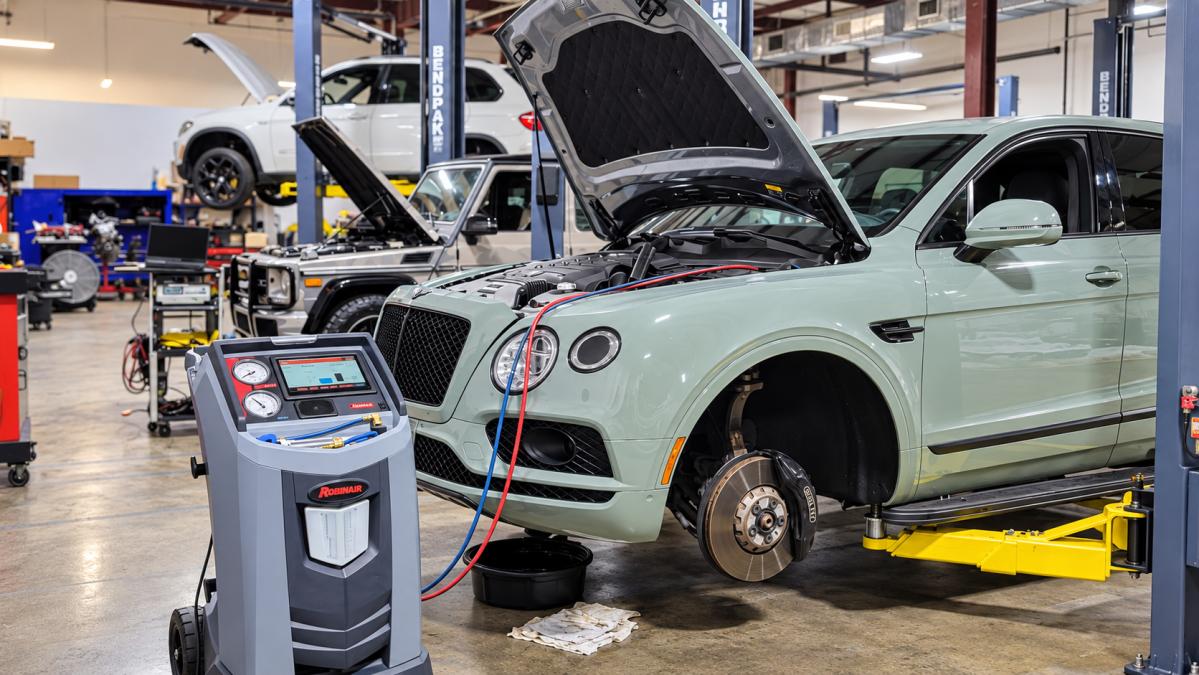
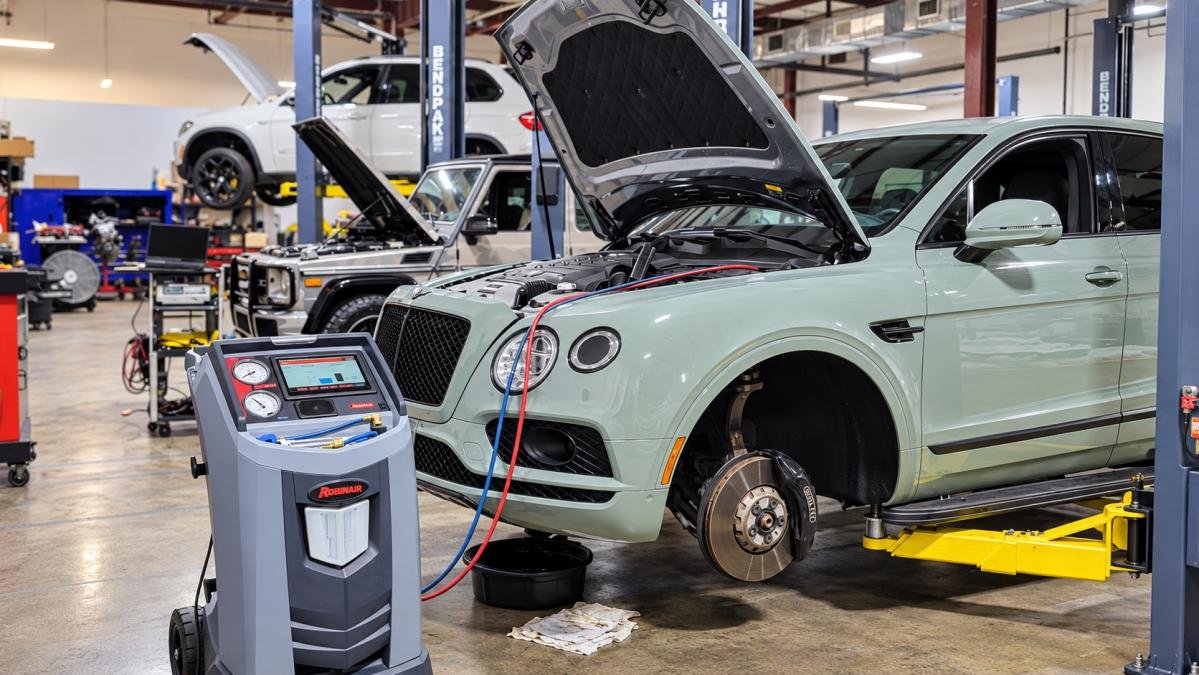
Professional technician using manifold gauge set with digital pressure readings visible on dual gauges connected to AC service ports on a European vehicle, in a well-lit service bay
Identifying leak location is essential because repair method depends on it: hose connection leaks may require tightening or o-ring replacement, hose leaks require hose replacement, and leaks at compressor seals, condenser seams, or evaporator connections often require component replacement.
Refrigerant Types and System Requirements
Modern vehicles use R-134a (standard in vehicles before 2017) or R-1234yf (required for vehicles after 2017, more environmentally friendly).
These refrigerants are not interchangeable. Using the wrong type damages the compressor, contaminates the system, and creates safety hazards. They have different pressure characteristics, oil requirements, and operating temperatures; mixing them produces acids and sludge.
Your vehicle’s service manual and the AC system label under the hood specify the correct refrigerant type and total charge amount. Always verify this information before opening the system or adding refrigerant.
R-134a systems typically charge 2.5-3.5 pounds; R-1234yf systems often require slightly less due to greater efficiency. Overcharging or undercharging both degrade cooling performance and damage the compressor.
AC Evacuation and Recharge Process
Proper AC system service requires complete evacuation before recharging. Evacuation removes all refrigerant and moisture from the sealed circuit using a vacuum pump. This step is critical because moisture inside the system causes acid formation, which damages compressor bearings and corrodes internal components.
A vacuum pump connected to the system’s service ports draws a deep vacuum, typically to 29.5 inches of mercury or lower. The system is held under vacuum for a specified time, often 15-30 minutes, to ensure all moisture is removed. The vacuum gauge reading tells the technician when the system has reached the target evacuation level.
After evacuation, the system must be recharged with the correct amount of refrigerant. This is done slowly and carefully, with pressure monitoring throughout the process. The technician adds refrigerant in small increments while watching manifold gauge readings and vent temperature. The goal is to reach the manufacturer’s specified charge amount while maintaining proper operating pressures.
Vent temperature verification is the final step. Once the system reaches the correct charge level, the AC is run and vent air temperature is measured. Proper cooling should produce vent temperatures in the 35-45 degree range. If vent temperature is too warm, additional refrigerant may be needed. If it’s too cold, the system may be overcharged.
The entire evacuation and recharge process typically requires specialized equipment: a vacuum pump, manifold gauges, a refrigerant recovery machine, and a scale or flow meter to measure exact refrigerant amounts. This is why professional Air Conditioning Service is necessary, these tools are expensive and require training to use correctly.
Climate Control Module Programming and Adaptation
Many European vehicles use climate control modules that require programming or adaptation after AC service. These modules control compressor engagement, blower speed, and temperature blend based on cabin temperature sensors and user inputs. When AC components are replaced or the system is serviced, the module may need to be reprogrammed to recognize the new configuration.
Some vehicles require basic programming, resetting the module so it recognizes that AC service has been performed.
DIY AC Service vs. Professional Repair
Refrigerant recharge kits sold at auto parts stores appeal to owners because they seem simple and affordable. However, they carry significant risks. These kits provide pre-measured refrigerant and a basic connection method, but they don’t include pressure gauges, vacuum equipment, or leak detection tools.
Preventative AC Maintenance Schedule
Regular AC system maintenance extends the life of components and prevents unexpected failures. Many owners think of AC service only when cooling performance drops, but preventative maintenance catches problems early.
Maintenance Task | Recommended Frequency | Purpose |
|---|---|---|
Pressure test and vent temperature check | Annually before cooling season | Detect refrigerant leaks early |
Cabin air filter replacement | Every 12-15 months | Maintain airflow and cooling efficiency |
Climate control module scan | Every 2 years | Identify electrical faults before failure |
Evaporator inspection | As needed if odors develop | Prevent mold and bacterial growth |
System flush | After compressor failure or contamination | Remove particles and acids from circuit |
Frequently Asked Questions
What’s the difference between R-134a and R-1234yf refrigerant?
R-134a is the older standard refrigerant used in most vehicles before 2017, while R-1234yf is the newer EPA-approved alternative with lower environmental impact. European manufacturers began transitioning to R-1234yf around 2011. The two are not interchangeable—using the wrong refrigerant damages your AC system and voids warranties. Your vehicle’s service manual specifies which type your system requires. Professional technicians verify this before any recharge.
Can I use an over-the-counter AC recharge kit on my European luxury vehicle?
Generic recharge kits carry significant risks for European vehicles, especially luxury models with advanced climate control systems. These kits lack the precision diagnostics needed to identify the real problem—whether it’s a leak, compressor failure, or electrical fault. Improper charging can damage the compressor clutch, thermal expansion valve, or condenser. European vehicles often require specialized diagnostic equipment and refrigerant oil compatibility verification. Professional service ensures system pressure, vent temperature, and component function are correct.
What does an AC system evacuation actually do?
Evacuation removes all refrigerant, oil, air, and moisture from your AC system using a vacuum pump. This step is critical because water vapor left in the system reacts with refrigerant to form corrosive acids that damage the compressor and expansion valve. The evacuation process typically takes 30-45 minutes to achieve proper vacuum levels. After evacuation, the system is recharged with fresh refrigerant and the correct amount of refrigerant oil. Skipping evacuation or rushing the process compromises system performance and longevity.
How often should I have my car’s AC system serviced?
Most manufacturers recommend an AC system inspection annually, especially before summer. If your system is functioning normally, a full evacuation and recharge isn’t necessary every year—only when performance drops or diagnostics show contamination or moisture. However, preventative maintenance of the cabin air filter, hose inspection for cracks, and o-ring seal checks should occur during regular service intervals. European vehicles benefit from annual pressure testing and thermal efficiency verification to catch leaks early before they become expensive repairs.